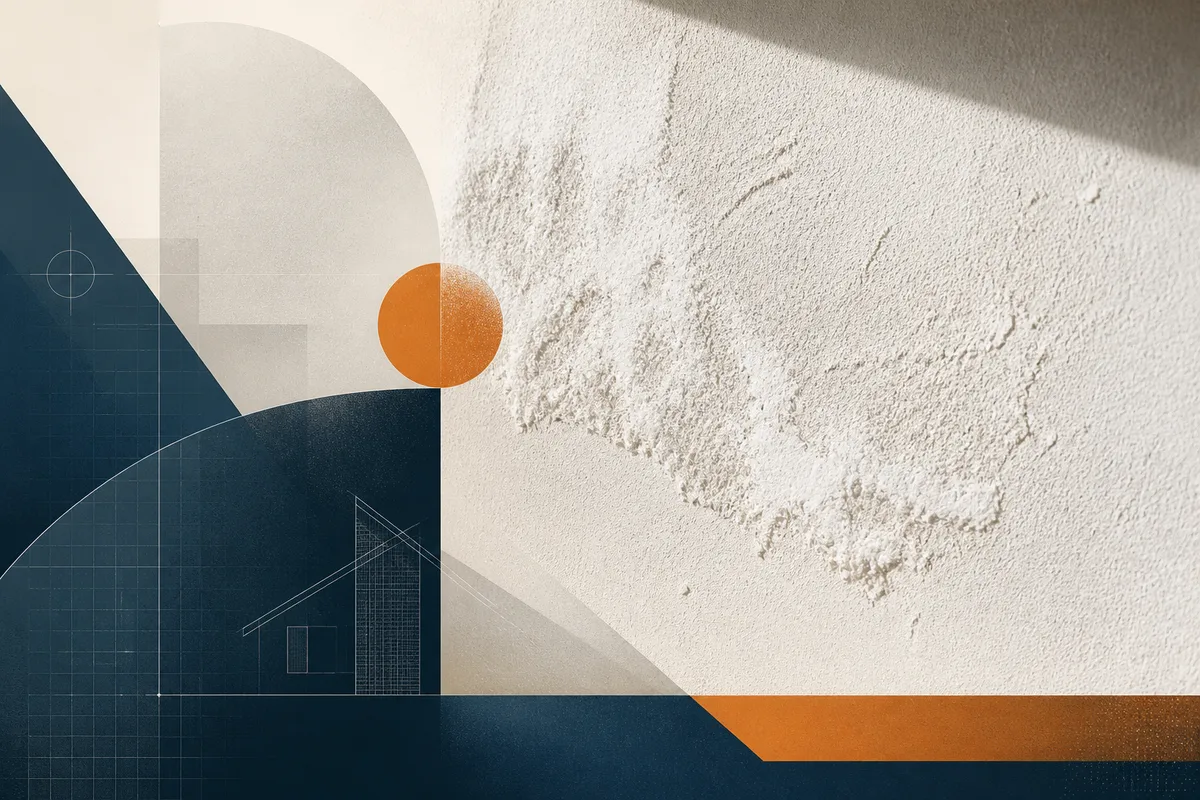
The Truth Behind the White Powder on Stucco Walls
Homeowners often mistake the white powder on stucco for mold or failing paint. In reality, this substance is efflorescence—a crystalline deposit of salts that occurs when water migrates through porous masonry. As the dry air in the East Valley causes moisture to evaporate, the salts previously dissolved in that water stay behind, hardening into a chalky crust.
Ignoring these deposits can lead to significant finish degradation and internal wall damage. This guide examines why these salts appear, how to identify the severity of the underlying moisture problem, and the operational steps required to remediate the source.
Why Efflorescence Signals a Drainage Failure
Efflorescence is a symptom, not a disease. It requires three specific conditions: water-soluble salts in the substrate, moisture to dissolve them, and a path for that moisture to reach the surface. When white powder appears, it confirms that the building envelope is currently acting as a filter for migrating water. According to Omega Products International, efflorescence is the result of water dissolving salts that are naturally present in portland cement plaster.
- Regional soils can provide a supply of minerals that move upward through the foundation via capillary action.
- Constant exposure to irrigation overspray forces water into the stucco faster than it can naturally breathe.
- Cracked finishes allow rainwater to bypass the outer layer, trapping moisture against the lath.
- Faulty or missing weep screeds prevent moisture from exiting the bottom of the wall, forcing it out through the face of the stucco.
The Playbook for Diagnosing Mineral Deposits
1Perform the Dry Rub Test
A simple way to identify the substance is to rub it with a gloved finger; efflorescence will turn into a fine, scentless powder that falls away easily. If the substance is fuzzy, dark, or difficult to smear, it may be biological growth rather than mineral salts.
2Identify the Moisture Source
Check the height of the staining relative to the ground. If the powder is concentrated at the base of the wall, it usually indicates groundwater wicking stucco issues where the soil sits too high against the foundation. Stains higher up often point to localized stucco crack repair needs or leaking window flashings.
3Evaluate the Weep Screed
Standard building practices require a metal or plastic weep screed at the base of the wall to allow drainage. If this component is buried by landscaping or blocked by a previous homeowner's DIY patch, moisture remains trapped. Clearing the drainage path is a non-negotiable step before any cosmetic work begins. Ensuring the stucco terminates properly above the ground or paved surfaces helps facilitate this drainage and protects the integrity of the slab.
4Test the Substrate Integrity
Use a firm tool to tap the area around the white powder. A hollow sound indicates that hydrostatic pressure has caused the stucco to delaminate from the lath. In these cases, cleaning the surface is useless; the compromised section must be removed and replaced to prevent further water intrusion.
Hydrostatic Pressure and Wicking Mechanisms
In arid climates, the evaporation rate is extremely high. The National Weather Service often records humidity levels below 25% in the region. This creates a "wicking" effect where the dry exterior air literally pulls moisture out of the cooler, wetter interior of the wall.
As water moves toward the low-humidity exterior, it carries salts from the cement and the soil. Once the water hits the air, it evaporates, leaving the salt crystals to grow. Over time, these crystals can expand within the pores of the stucco—a process called subflorescence—which creates enough internal pressure to pop the finish off the wall.
How Chandler Stucco Repair Helps
Addressing efflorescence involves more than a pressure washer. A proper scope of work starts with a site inspection to determine if the moisture is coming from ground saturation, plumbing leaks, or atmospheric intrusion. Technicians typically clean the affected area with a mild acid solution or stiff brush to remove the salts without damaging the underlying texture. If the intrusion has caused structural cracking, a comprehensive repair plan will include sealing the entry points and ensuring the weep system is functional. For general building inspection questions or to discuss local requirements, residents can contact the Building Inspections Manager at 480-782-3109. For an evaluation of your property's exterior, you can reach out to (480) 605-4474 or request a consultation online.
Frequently asked questions
Can I just paint over the white powder?
Painting over efflorescence is a temporary fix that usually leads to larger failures. The salts will continue to expand under the new paint film, causing it to bubble and peel within months. The salts must be neutralized and the water source stopped before applying any new coating.
Is the white powder dangerous to my health?
Unlike mold, mineral efflorescence is generally inert and does not pose a respiratory threat. However, the moisture that causes it can eventually lead to mold growth inside the wall cavity if the drainage issue is not addressed.
Why does the powder return after I wash it off?
If the wall is washed with a hose, it may provide the exact moisture needed to bring more salts to the surface. If the underlying source—such as high soil levels or a leaky pipe—isn't fixed, the cycle of evaporation and crystallization will continue indefinitely.
Does the City of Chandler have rules about stucco drainage?
While specific numeric height requirements vary by the year of construction and specific site conditions, the city manages stucco drainage and termination through its standard inspection process. Property owners can coordinate through the Maricopa County permit center or the local Building Safety department to verify compliance.
Is efflorescence a sign that my stucco was mixed poorly?
Not necessarily. While high-salt sand can contribute to the problem, even the best-mixed stucco will exhibit efflorescence if it is subjected to constant water saturation. The issue is almost always related to drainage and moisture management rather than the original material quality.
What happens when you get in touch: you describe the situation, we ask the few questions that actually change the answer, and you get a clear scope and next step — no obligation.